Androscoggin Lake: Algal Bloom Response
To support the fight against algal blooms on Androscoggin Lake, you can make a donation to Keep it Blue!
Latest Updates
30 Mile will update this webpage as information becomes available
9/18/2026 – Lake Status Update
Subtidal Buoy: Currently, the real-time monitoring buoy is detecting elevated levels of cyanobacteria. This sensor-based estimate considers these levels to have the potential to produce toxins, listing current conditions as Warning. Their advisory level is defined as an estimated over 90% chance (9 in 10) that toxins are above the safe level.
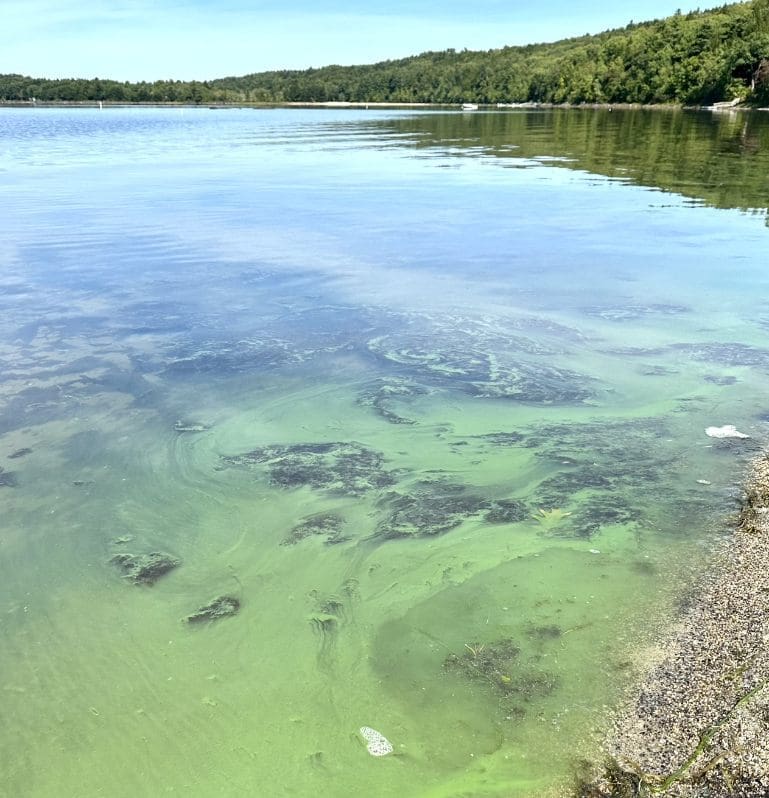
Scum Reports: While we still have not yet reached the Maine DEP-defined threshold for a lake-wide algal bloom, reports of scum accumulations have been recorded. You can view our near-live data on the Androscoggin Lake page.
Report Scum Sightings: If you notice scum accumulations along your shoreline, please notify Sara at sara@30mileriver.org with images, date, time, and location of the observation. 30 Mile is looking to collect scum samples and utilize toxin test strips. Having more eyes on the water to notify when these conditions occur are extremely helpful.
Please refer to this Maine DEP webpage for more information and follow the guidelines in the previous update below.
Photo from Terry Brooks on 9/15/2026
9/7/2026 – Lake Status Update
Subtidal Buoy: Currently, the real-time monitoring buoy is detecting elevated levels of cyanobacteria. This sensor-based estimate considers these levels to have the potential to produce toxins, listing current conditions as Advisory. Their advisory level is defined as an estimated over 75% chance (more than 3 in 4) that toxins are above the safe level.
Declining clarity: We have observed a decline in water clarity over the past few weeks, but have not reached the Maine DEP-defined threshold for a lake-wide algal bloom. You can view our near-live data on the Androscoggin Lake page.
Please refer to this Maine DEP webpage for more information and follow these guidelines:
-
Do not accidentally ingest or drink lake water during a bloom. Well-maintained domestic water treatment systems may make lake water safe to drink by removing bacteria and parasites, but they are not guaranteed to remove algal toxins.
-
If you shower with lake water, keep showers brief because breathing toxins in shower mist could cause health issues.
-
Do not swim, water ski, or boat in areas where algae are visible (e.g., pea soup, floating mats, scum layers, etc.), where water is discolored, or where musty odors are present.
-
Rules of thumb: if you are standing in water chest deep (4-5 feet ) and you can’t see your toes because the water is so green, you should get out; if you are looking into water that is 4-5 feet deep and can’t see the bottom of the lake because the water is so green, you should not to go in.
-
Because algal scums along the shoreline have the highest concentrations of toxins, do not let children play in water that is discolored, where you see mats of algal material, foam, or where musty odors are present. Do not allow pets or livestock to swim or drink water from these areas.
-
Rinse off with fresh water and soap if available, as soon as practical if exposed to water that has dense algae present. This will reduce skin exposure for humans and pets.
If you believe you are seeing algal scum accumulations, be sure to contact Sara at sara@30mileriver.org and refer to the additional guidelines below on what to do when you suspect a bloom.
8/22/2026 – Lake status, DO Transects, Peer Review, Funding, and Monitoring Buoy
Lake Status: During monitoring on Tuesday, August 18th, the clarity readings were 3.3m (10.9ft). While we are seeing a decline, these readings are higher than last year. This level of clarity had already been reached during the first week of August, with lake-wide algal bloom status recorded by August 15th, 2025. To see more of our near-live data, visit the Androscoggin Lake page.
DO Transects Complete: The Lake reached its typical peak anoxia (dissolved oxygen levels below 2mg/L). This occurs in late July to early August. We have completed our day on the lake collecting dissolved oxygen (DO) readings across different lake sections to determine if anoxic conditions impact phosphorus release in shallow areas. Ecological Instincts is currently reviewing the results. .
Peer Review: 30 Mile has received a draft of the peer review completed by our engineering consultants at VHB. Before it is finalized, it will be reviewed by the Technical Advisory Committee.
Grant Funding: The Town of Wayne has approved the motion to accept the $80k conditional grant funding from the Maine Department of Environmental Protection and subcontract with 30-Mile River Watershed for the Androscoggin Lake Watershed-Based Plan Development Project.
Monitoring Buoy: Please do not approach the buoy. This buoy is anchored and its mooring line contains sensors that can be damaged if snagged.
On August 5th, we deployed a continuous monitoring buoy at the deep hole monitoring station of the lake. It collects data around the clock at the surface and bottom of the lake. This buoy will not replace our bi-weekly monitoring and sampling efforts, but will provide additional data, notifying us exactly when changes in the lake occur. It will also predict when and where toxins could be present and concentrating along shorelines, based on wind and wave information. This buoy is contracted by Subtidal.
On August 14th, the buoy was removed due to malfunctions. A new buoy has been installed today (8/21/2026).
8/5/2026 – Monitoring Buoy installed
If you see the buoy pictured here, please be cautious boating nearby and do not disturb. Thank you!
Today, a continuous monitoring buoy has been installed through a program with Subtidal. This buoy will collect data at the surface and bottom of the lake, recording phycocyanin, chlorophyll a, dissolved oxygen, temperature, and turbidity. We will provide more details on accessing this data and how it functions soon.

7/29/2026 – What to do when you see green and suspect a bloom
30 Mile staff monitor on the Lake every two weeks, with volunteer monitors assessing water clarity during the weeks in between. Even with this data collected weekly, conditions can change rapidly. It can be helpful to have additional observations of what you see happening on the lake.
Familiarize yourself with what else may be in the water. There are many things that make up a lake’s ecosystem. Sometimes, things we see are concerning, but other times they are a natural part of a healthy lake. Explore A Field Guide to Aquatic Phenomena and our article “What’s that stuff in the water?” to see if what you are seeing is something other than cyanobacteria.
If you still see what could be an algal bloom, you can contact sara@30mileriver.org and do the following:
- Take photos. Be sure to record the time, date, location, and other observations (smell, size of the algae area, colors, etc.).
- Submit a report. The Maine DEP has a bloom reporting dashboard. You can submit potential blooms for their review here.
- Take a Jar Test. All you need is a clear, pint to quart sized jar to collect a sample of the suspect algae. By letting it sit undisturbed overnight, you can determine if it is possibly cyanobacteria by the way it settles in the jar. Follow the complete instructions here.
7/24/2026 – Bathymetry, Peer Review, Surveys, and Funding Updates
Bathymetry and Sediment Sampling: We have received the updated bathymetric maps for Androscoggin Lake from the US EPA. These provide a detailed understanding of the lake’s depths. The EPA collected data last fall and worked over the winter to render these maps. With this new information, our environmental consultant, Ecological Instincts, can move forward with determining locations for sediment cores to be collected. Collection will be done by the Maine DEP and supported by 30 Mile staff. These samples will be analyzed to help us better understand how the lake’s sediments are impacting its health. You can view the map here.
Engineering Peer Review Study: Our engineering consultants at VHB held a meeting with a few members of the community with local knowledge of Dead River PCD operations and maintenance. They are continuing to work on completing a peer review of the previously completed E-Pro engineering study from 2002-03. Their review will focus on assessing consistency in methodology, data sources, and study results with current engineering best practices, as well as suggestions for future modeling or investigations.
Agricultural Surveys: Last week, the Ecological Instincts team completed their field survey to verify land cover types for their land cover analysis. They had previously completed a draft of their desktop analysis, which will now be updated with these survey results. Assessing land cover helps determine the extent of nutrients and sediments that could be entering the lake from the watershed.
Grant Funding Updates: Lastly, we have received news that the Town of Wayne has been conditionally awarded the requested Maine DEP 604(b) grant funds from the proposal that 30 Mile submitted in May.
6/30/2026 – Engineering consultant to complete peer review analysis
30 Mile has contracted with VHB Engineering, a national firm with an office in Augusta. VHB will provide consultant services to evaluate the Dead River Pollution Control Device (“dam”) and its role in water quality on Androscoggin Lake. A portion of ALIC’s $25,000 commitment to the algal bloom study project will fund this work.
The scope of VHB’s work will involve a peer review analysis of the extensive E‑Pro engineering studies completed in 2002-03. Those studies comprehensively evaluated the Dam and its effectiveness in limiting phosphorus entering Androscoggin Lake from Androscoggin River backflow through the Dead River. VHB’s review will also recommend any additional study needed to evaluate watershed conditions that may have changed significantly since the early 2000s.
6/15/2026 – Funding and monitoring update
On June 10th, Wayne voters attending Town Meeting approved Wayne supporting this project with $15,000. Thank you to everyone who came to
6/3/2026 – Algal Bloom Forum
Thank you to everyone who attended the Androscoggin Algal Bloom Forum in person or online. If you weren’t able to attend, the presentations and Q&A have been recorded and are available to watch (or rewatch) at http://youtu.be/C9z3WJVmZzs. We are working to update our Q&A page to reflect new questions as soon as possible.
Forum summary:
Sara York, 30 Mile’s Water Quality Specialist, reviewed progress made since the previous forum in November;
- Organized the Androscoggin Lake Steering Committee: 8 people representing Wayne, Leeds, ALIC, 30 Mile, businesses, lakefront owners, and lake users that will guide four work groups (science, government, fundraising, communications).
- Secured funding: Maine Outdoor Heritage Fund, ALIC, 30 Mile, the Town of Leeds, With pending funding from the Town of Wayne and Maine DEP
- Hired consultants: Ecological Instincts (Jen Jesperson) for watershed planning and VHB Engineering for the Dead River dam peer review study.
Jen Jesperson of Ecological Instincts, the hired environmental consultant for this project, spoke about the work she will be doing to complete the nine-element watershed-based management plan. This plan is essential for understanding current causes and sources to develop scientifically sound lake and watershed restoration strategies. She highlighted;
- Androscoggin Lake has sensitive sediment chemistry and is above the phosphorus threshold where it becomes more likely to sustain algal blooms. But there is still potential for recovery.
- Phosphorus levels being investigated include external loading such as runoff from the watershed (roads, driveways, agriculture, septic systems, the Dead River backflushing), and internal loading (phosphorus released from lake bottom sediments when oxygen is depleted).
- Watershed modeling and analysis will be completed to determine the major sources of phosphorus, their relative contributions, and how much needs to be reduced.
Sara York, reviewed the data collection to be completed and utilized this season;
- Updated lake bathymetry mapping (depth/volume map)
- Sediment core sampling (10+ locations)
- Monthly/bi-weekly plankton sampling to identify cyanobacteria species and abundance
- Dissolved oxygen surveys across lake to determine if anoxic conditions impact phosphorus in shallow areas
- Storm runoff sampling from tributaries
- ADCP instrument and gauges on the Dead River to measure backflushing events and water levels
- Peer review of 2000s-era Dead River dam studies
- Updating septic records for a septic system loading analysis
To help support this work, you can donate to the “Keep It Blue” campaign here.
6/1/2026 – Funding and monitoring update
In May, the Maine Outdoor Heritage Fund (MOHF) Board voted unanimously to fund the 30 Mile River Watershed Association’s grant application for work on Androscoggin Lake. This $25K grant will support an environmental assessment to identify the causes of the algal blooms and management strategies to protect public health. Project partners include Maine DEP, ALIC, and the towns of Wayne and Leeds.
Work has already begun this spring with intensified data collection that will continue throughout the summer and fall, including sediment sampling (10+ locations), plankton sampling, stream sampling (10+ locations), dissolved oxygen transects, and recording backflushing events of the Dead River. Data collection will be conducted by 30 Mile staff, and supported by trained volunteers and Maine DEP. This data will inform the work to be completed by Ecological Instincts, which will include phosphorus loading analyses, watershed modeling, and more, all leading toward developing a U.S. EPA-approved Nine-Element Watershed-Based Management Plan (required for certain grant eligibility). Completing this extensive, science-based work will help us better understand the factors causing the blooms and evaluate potential solutions to help prevent them.
5/1/2026 – Androscoggin algal bloom Work Groups update
The Androscoggin Lake Steering Committee’s four Work Groups (science, government, communications, and fundraising) have been assigned and have conducted initial planning meetings. Over 30 volunteers signed up and will be participating in a wide variety of tasks. Work over the next month will include applying for grants, finalizing data collection methodologies, planning summer events, reviewing ordinances, and building relationships with local, state and federal representatives. Work with the technical team, which includes lake science experts, DEP staff, engineers, and 30 Mile staff, is also underway, with an immediate focus on the Dead River.
The next public forum is planned for Wednesday evening, June 3rd, 2026, at the Wayne Community Church. Jen Jespersen of Ecological Instincts, the consultant hired to conduct the data analysis, modeling, and planning for remediation efforts, will be speaking about their progress to date. Additional forum details will be available soon.
At their April town meeting, the Town of Leeds approved $5,000 to support this work. The request for funding from Wayne will be voted on at June’s town meeting.
Updates, FAQs, and additional information on Androscoggin Lake’s algal blooms can be found at 30mileriver.org/androscoggin-bloom.
The Androscoggin Lake Steering Committee represents Wayne, Leeds, ALIC, 30 Mile, businesses, lakefront owners, and lake users – all working together to provide a forum for meaningful citizen dialogue and discussion to foster a realistic and timely action plan to restore the health of Androscoggin Lake.
Latest Updates
30 Mile will update this webpage as information becomes available
9/7/2026 – Lake Status Update
Subtidal Buoy: Currently, the real-time monitoring buoy is detecting elevated levels of cyanobacteria. This sensor-based estimate considers these levels to have the potential to produce toxins, listing current conditions as Advisory. Their advisory level is defined as an estimated over 75% chance (more than 3 in 4) that toxins are above the safe level.
Declining clarity: We have observed a decline in water clarity over the past few weeks, but have not reached the Maine DEP-defined threshold for a lake-wide algal bloom. You can view our near-live data on the Androscoggin Lake page.
Please refer to this Maine DEP webpage for more information and follow these guidelines:
-
Do not accidentally ingest or drink lake water during a bloom. Well-maintained domestic water treatment systems may make lake water safe to drink by removing bacteria and parasites, but they are not guaranteed to remove algal toxins.
-
If you shower with lake water, keep showers brief because breathing toxins in shower mist could cause health issues.
-
Do not swim, water ski, or boat in areas where algae are visible (e.g., pea soup, floating mats, scum layers, etc.), where water is discolored, or where musty odors are present.
-
Rules of thumb: if you are standing in water chest deep (4-5 feet ) and you can’t see your toes because the water is so green, you should get out; if you are looking into water that is 4-5 feet deep and can’t see the bottom of the lake because the water is so green, you should not to go in.
-
Because algal scums along the shoreline have the highest concentrations of toxins, do not let children play in water that is discolored, where you see mats of algal material, foam, or where musty odors are present. Do not allow pets or livestock to swim or drink water from these areas.
-
Rinse off with fresh water and soap if available, as soon as practical if exposed to water that has dense algae present. This will reduce skin exposure for humans and pets.
If you believe you are seeing algal scum accumulations, be sure to contact Sara at sara@30mileriver.org and refer to the additional guidelines below on what to do when you suspect a bloom.
8/22/2026 – Lake status, DO Transects, Peer Review, Funding, and Monitoring Buoy
Lake Status: During monitoring on Tuesday, August 18th, the clarity readings were 3.3m (10.9ft). While we are seeing a decline, these readings are higher than last year. This level of clarity had already been reached during the first week of August, with lake-wide algal bloom status recorded by August 15th, 2025. To see more of our near-live data, visit the Androscoggin Lake page.
DO Transects Complete: The Lake reached its typical peak anoxia (dissolved oxygen levels below 2mg/L). This occurs in late July to early August. We have completed our day on the lake collecting dissolved oxygen (DO) readings across different lake sections to determine if anoxic conditions impact phosphorus release in shallow areas. Ecological Instincts is currently reviewing the results. .
Peer Review: 30 Mile has received a draft of the peer review completed by our engineering consultants at VHB. Before it is finalized, it will be reviewed by the Technical Advisory Committee.
Grant Funding: The Town of Wayne has approved the motion to accept the $80k conditional grant funding from the Maine Department of Environmental Protection and subcontract with 30-Mile River Watershed for the Androscoggin Lake Watershed-Based Plan Development Project.
Monitoring Buoy: Please do not approach the buoy. This buoy is anchored and its mooring line contains sensors that can be damaged if snagged.
On August 5th, we deployed a continuous monitoring buoy at the deep hole monitoring station of the lake. It collects data around the clock at the surface and bottom of the lake. This buoy will not replace our bi-weekly monitoring and sampling efforts, but will provide additional data, notifying us exactly when changes in the lake occur. It will also predict when and where toxins could be present and concentrating along shorelines, based on wind and wave information. This buoy is contracted by Subtidal.
On August 14th, the buoy was removed due to malfunctions. A new buoy has been installed today (8/21/2026).
8/5/2026 – Monitoring Buoy installed
If you see the buoy pictured here, please be cautious boating nearby and do not disturb. Thank you!
Today, a continuous monitoring buoy has been installed through a program with Subtidal. This buoy will collect data at the surface and bottom of the lake, recording phycocyanin, chlorophyll a, dissolved oxygen, temperature, and turbidity. We will provide more details on accessing this data and how it functions soon.
7/29/2026 – What to do when you see green and suspect a bloom
30 Mile staff monitor on the Lake every two weeks, with volunteer monitors assessing water clarity during the weeks in between. Even with this data collected weekly, conditions can change rapidly. It can be helpful to have additional observations of what you see happening on the lake.
Familiarize yourself with what else may be in the water. There are many things that make up a lake’s ecosystem. Sometimes, things we see are concerning, but other times they are a natural part of a healthy lake. Explore A Field Guide to Aquatic Phenomena and our article “What’s that stuff in the water?” to see if what you are seeing is something other than cyanobacteria.
If you still see what could be an algal bloom, you can contact sara@30mileriver.org and do the following:
- Take photos. Be sure to record the time, date, location, and other observations (smell, size of the algae area, colors, etc.).
- Submit a report. The Maine DEP has a bloom reporting dashboard. You can submit potential blooms for their review here.
- Take a Jar Test. All you need is a clear, pint to quart sized jar to collect a sample of the suspect algae. By letting it sit undisturbed overnight, you can determine if it is possibly cyanobacteria by the way it settles in the jar. Follow the complete instructions here.
7/24/2026 – Bathymetry, Peer Review, Surveys, and Funding Updates
Bathymetry and Sediment Sampling: We have received the updated bathymetric maps for Androscoggin Lake from the US EPA. These provide a detailed understanding of the lake’s depths. The EPA collected data last fall and worked over the winter to render these maps. With this new information, our environmental consultant, Ecological Instincts, can move forward with determining locations for sediment cores to be collected. Collection will be done by the Maine DEP and supported by 30 Mile staff. These samples will be analyzed to help us better understand how the lake’s sediments are impacting its health. You can view the map here.
Engineering Peer Review Study: Our engineering consultants at VHB held a meeting with a few members of the community with local knowledge of Dead River PCD operations and maintenance. They are continuing to work on completing a peer review of the previously completed E-Pro engineering study from 2002-03. Their review will focus on assessing consistency in methodology, data sources, and study results with current engineering best practices, as well as suggestions for future modeling or investigations.
Agricultural Surveys: Last week, the Ecological Instincts team completed their field survey to verify land cover types for their land cover analysis. They had previously completed a draft of their desktop analysis, which will now be updated with these survey results. Assessing land cover helps determine the extent of nutrients and sediments that could be entering the lake from the watershed.
Grant Funding Updates: Lastly, we have received news that the Town of Wayne has been conditionally awarded the requested Maine DEP 604(b) grant funds from the proposal that 30 Mile submitted in May.
6/30/2026 – Engineering consultant to complete peer review analysis
30 Mile has contracted with VHB Engineering, a national firm with an office in Augusta. VHB will provide consultant services to evaluate the Dead River Pollution Control Device (“dam”) and its role in water quality on Androscoggin Lake. A portion of ALIC’s $25,000 commitment to the algal bloom study project will fund this work.
The scope of VHB’s work will involve a peer review analysis of the extensive E‑Pro engineering studies completed in 2002-03. Those studies comprehensively evaluated the Dam and its effectiveness in limiting phosphorus entering Androscoggin Lake from Androscoggin River backflow through the Dead River. VHB’s review will also recommend any additional study needed to evaluate watershed conditions that may have changed significantly since the early 2000s.
6/15/2026 – Funding and monitoring update
On June 10th, Wayne voters attending Town Meeting approved Wayne supporting this project with $15,000. Thank you to everyone who came to
6/3/2026 – Algal Bloom Forum
Thank you to everyone who attended the Androscoggin Algal Bloom Forum in person or online. If you weren’t able to attend, the presentations and Q&A have been recorded and are available to watch (or rewatch) at http://youtu.be/C9z3WJVmZzs. We are working to update our Q&A page to reflect new questions as soon as possible.
Forum summary:
Sara York, 30 Mile’s Water Quality Specialist, reviewed progress made since the previous forum in November;
- Organized the Androscoggin Lake Steering Committee: 8 people representing Wayne, Leeds, ALIC, 30 Mile, businesses, lakefront owners, and lake users that will guide four work groups (science, government, fundraising, communications).
- Secured funding: Maine Outdoor Heritage Fund, ALIC, 30 Mile, the Town of Leeds, With pending funding from the Town of Wayne and Maine DEP
- Hired consultants: Ecological Instincts (Jen Jesperson) for watershed planning and VHB Engineering for the Dead River dam peer review study.
Jen Jesperson of Ecological Instincts, the hired environmental consultant for this project, spoke about the work she will be doing to complete the nine-element watershed-based management plan. This plan is essential for understanding current causes and sources to develop scientifically sound lake and watershed restoration strategies. She highlighted;
- Androscoggin Lake has sensitive sediment chemistry and is above the phosphorus threshold where it becomes more likely to sustain algal blooms. But there is still potential for recovery.
- Phosphorus levels being investigated include external loading such as runoff from the watershed (roads, driveways, agriculture, septic systems, the Dead River backflushing), and internal loading (phosphorus released from lake bottom sediments when oxygen is depleted).
- Watershed modeling and analysis will be completed to determine the major sources of phosphorus, their relative contributions, and how much needs to be reduced.
Sara York, reviewed the data collection to be completed and utilized this season;
- Updated lake bathymetry mapping (depth/volume map)
- Sediment core sampling (10+ locations)
- Monthly/bi-weekly plankton sampling to identify cyanobacteria species and abundance
- Dissolved oxygen surveys across lake to determine if anoxic conditions impact phosphorus in shallow areas
- Storm runoff sampling from tributaries
- ADCP instrument and gauges on the Dead River to measure backflushing events and water levels
- Peer review of 2000s-era Dead River dam studies
- Updating septic records for a septic system loading analysis
To help support this work, you can donate to the “Keep It Blue” campaign here.
6/1/2026 – Funding and monitoring update
In May, the Maine Outdoor Heritage Fund (MOHF) Board voted unanimously to fund the 30 Mile River Watershed Association’s grant application for work on Androscoggin Lake. This $25K grant will support an environmental assessment to identify the causes of the algal blooms and management strategies to protect public health. Project partners include Maine DEP, ALIC, and the towns of Wayne and Leeds.
Work has already begun this spring with intensified data collection that will continue throughout the summer and fall, including sediment sampling (10+ locations), plankton sampling, stream sampling (10+ locations), dissolved oxygen transects, and recording backflushing events of the Dead River. Data collection will be conducted by 30 Mile staff, and supported by trained volunteers and Maine DEP. This data will inform the work to be completed by Ecological Instincts, which will include phosphorus loading analyses, watershed modeling, and more, all leading toward developing a U.S. EPA-approved Nine-Element Watershed-Based Management Plan (required for certain grant eligibility). Completing this extensive, science-based work will help us better understand the factors causing the blooms and evaluate potential solutions to help prevent them.
5/1/2026 – Androscoggin algal bloom Work Groups update
The Androscoggin Lake Steering Committee’s four Work Groups (science, government, communications, and fundraising) have been assigned and have conducted initial planning meetings. Over 30 volunteers signed up and will be participating in a wide variety of tasks. Work over the next month will include applying for grants, finalizing data collection methodologies, planning summer events, reviewing ordinances, and building relationships with local, state and federal representatives. Work with the technical team, which includes lake science experts, DEP staff, engineers, and 30 Mile staff, is also underway, with an immediate focus on the Dead River.
The next public forum is planned for Wednesday evening, June 3rd, 2026, at the Wayne Community Church. Jen Jespersen of Ecological Instincts, the consultant hired to conduct the data analysis, modeling, and planning for remediation efforts, will be speaking about their progress to date. Additional forum details will be available soon.
At their April town meeting, the Town of Leeds approved $5,000 to support this work. The request for funding from Wayne will be voted on at June’s town meeting.
Updates, FAQs, and additional information on Androscoggin Lake’s algal blooms can be found at 30mileriver.org/androscoggin-bloom.
The Androscoggin Lake Steering Committee represents Wayne, Leeds, ALIC, 30 Mile, businesses, lakefront owners, and lake users – all working together to provide a forum for meaningful citizen dialogue and discussion to foster a realistic and timely action plan to restore the health of Androscoggin Lake.
Suspect a bloom?
- Contact sara@30mileriver.org with photos, descriptions, location, and date.
- Submit a report to the Maine DEP bloom reporting dashboard
- Take a jar test following the instructions here.
Questions? Contact Sara, Water Quality Specialist at sara@30mileriver.org
Background
Androscoggin Lake experienced a severe cyanobacteria bloom during 2021, 2023, 2024, and 2025. Near-bloom conditions were documented in 2022. Maine Department of Environmental Protection (Maine DEP) defines a “lake-wide algal bloom” when water clarity <2 meters (~6 feet) depth at the deepest point in the lake (monitoring station #1).
What you need to know:
- The blooms in Androscoggin Lake have consisted of cyanobacteria (formerly called blue-green algae)
- Cyanobacteria can bloom when there’s too much phosphorus in the lake.
- Some species of cyanobacteria can produce toxins under certain conditions
- Not all cyanobacteria blooms are toxic
- Areas where the algae have concentrated, forming dense scums or accumulations, should be avoided by humans, pets, and livestock
- Avoid swallowing lake water while swimming, and do not allow pets or livestock to drink lake water
- Avoid using lake water for household uses, cooking, or drinking
- Shower and wash swimsuits after swimming
What causes algal blooms?
Cyanobacteria rely on three things: light, temperature, and nutrients. When it rains, phosphorus enters the lake via stormwater runoff that is delivered from the land in the watershed surrounding the lake. Phosphorus is a naturally occurring nutrient found in soil, fertilizers, pet and livestock waste, and septic systems among other sources. It is found in very small amounts in the lake water, but is found in very large amounts on land in the watershed surrounding the lake. Every time it rains, water flows over the land and flows downhill – into the ditches, streams, and Androscoggin Lake. When too much phosphorus enters the lake, excess algae growth occurs.
Another important source of phosphorus is the sediments at the lake bottom. In the summer months, low oxygen levels in the deep waters of the lake can cause a chemical reaction to occur in the sediment. This reaction causes the sediment to release phosphorus into the water — a phenomenon known as “internal phosphorus loading”. To learn more, please read Androscoggin Lake’s 2023 Water Quality Report here: https://30mileriver.org/androscoggin-lake/.
For more information about algae blooms and cyanobacteria, please visit Maine DEP’s informational webpages via the following links:
Algal Bloom Information
What are cyanobacteria?
Cyanobacteria are a type of algae. Formerly called blue-green algae, cyanobacteria are aquatic bacteria that are able to photosynthesize. Originally called blue-green algae because dense blooms will turn the water green, or blue-green in color, cyanobacteria are a natural and important part of the lake ecosystem, and can be found in all lakes all over the world. However, when nutrient (phosphorus) concentrations are high enough and conditions are just right, their population can explode. The result is what we call a “cyanobacteria bloom” or “algal bloom.”
What kind of cyanobacteria is it?
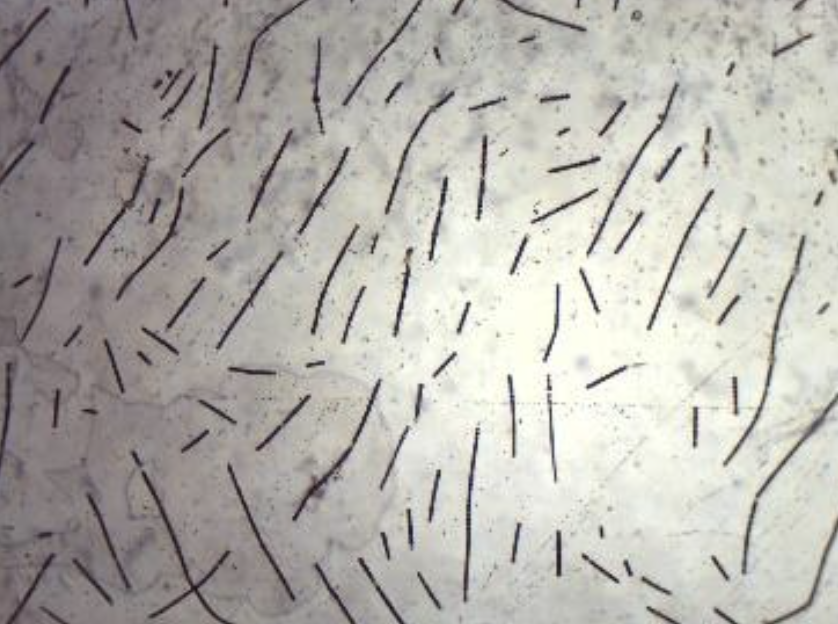
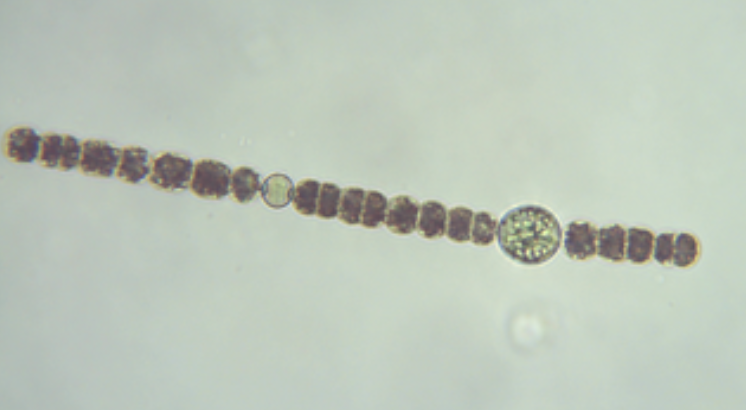
The species of cyanobacteria have been identified as Dolichospermum (formerly known as Anabaena), a common bloom-forming species in Maine lakes. Microscope photos (right, courtesy of R. Windecker) show the filamentous algae consisting of multiple bead-like cells of three distinct cell types. Dolichospermum can produce toxins under certain environmental conditions.
Is the water toxic?
We do know that the species causing this bloom has the ability to produce toxin. We are collecting water samples for toxin analysis by US EPA, however test results are not immediate.
Maine DEP has been testing for cyanotoxins in Maine lakes for decades. Of all the toxin samples Maine DEP has collected, there were only a few open-water samples that exceeded EPA’s Drinking Water standard for the algal toxin microcystin for infants and non-school-age children. None of the samples exceeded the standard for school-age children or adults. No open water samples have exceeded EPA’s Recreational Standard – even when collected from lakes with blooms that are chronic and severe.
However, Maine DEP has detected very high concentrations of the algal toxin microcystin in down-wind algal scums that can accumulate along shorelines. This is why we advise everyone to stay away from any concentrated scums or accumulations near shorelines or in down-wind coves. Do not inadvertently drink the water in these areas, and do not let small children, pets, or livestock play in these areas or drink from the lake. Shower after swimming, and do not use lake water for household uses like cooking or drinking.
Out of an abundance of caution: When in Doubt -Stay Out!
What you can do RIGHT NOW to help:
-
- Donate to 30 Mile to support our water quality monitoring program and our work to address this problem: https://30mileriver.org/ways-to-give/
- Become a member of the Androscoggin Lake Improvement Corporation (ALIC) https://androscogginlake.org/alic/how-to-help/donate/
- Be an advocate for lake protection at the town level. Local select boards, planning boards, and code enforcement officers all make decisions that can impact the lake.
- Share this information with your friends, family and neighbors. Be an ambassador for the lake!
- Address erosion on your property. Exposed soil delivers phosphorus to the lake each time it rains. Phosphorus feeds algae in the lake!
- If you are a landowner with an erosion site identified during the 2022 watershed survey, contact 30 Mile to see what cost-sharing opportunities are available to help implement your project!
- Establish or improve the vegetation on your shoreline. The bigger (wider) your shoreline buffer, the better it is for Androscoggin Lake.
- Do you live on a camp road? Gravel roads can be a huge polluter of the lake when sediment and pollutants from the road flow into streams and lakes during rain events. Be sure that your road isn’t part of the problem. Contact 30 Mile for technical assistance and learn more about how to maintain your road and protect the lake: https://www.maine.gov/dep/land/watershed/camp/road/gravel_road_manual.pdf
- Become LakeSmart! Contact ALIC’s LakeSmart team to receive a FREE property visit to learn more about how you can improve your property for the benefit of Androscoggin Lake. Visit https://www.lakes.me/lakesmart to learn more about this fantastic statewide program!
- Stop using fertilizers on your lakefront properties
- Maintain a healthy septic system, and pump your septic tank regularly. Visit https://30mileriver.org/septic-system-vulnerability-study/ to learn more about proper septic maintenance and go through our questionnaire to learn what else you can do to properly maintain your system.
- Volunteer. Help support water quality monitoring and LakeSmart. Sign up here: https://30mileriver.org/volunteer/
Learn more about how you can reduce your impact by visiting Maine DEP’s website for Shorefront Property Owners: https://www.maine.gov/dep/land/watershed/camp/index.html or Maine Lake’s Lake Library: https://www.lakes.me/library.
Where can I learn more information?
Algal Blooms in Maine Lakes (Maine DEP): https://www.maine.gov/dep/water/lakes/algalbloom.html
Cyanobacteria and Toxins (Maine DEP): https://www.maine.gov/dep/water/lakes/cyanobacteria.html
Most recent water quality data and reports (30 Mile): https://30mileriver.org/androscoggin-lake/
Most recent information about blooms in Androscoggin Lake, and what 30 Mile and ALIC are doing in response: https://30mileriver.org/androscoggin-bloom/
Near-Live Water Quality Data & Annual Monitoring Reports
30 Mile continues to monitor Androscoggin Lake into October to document improved conditions in the lake. Over the winter months, we will analyze the data and compile our findings into an annual water quality monitoring report, which will be available via our website once complete.
In the meantime, be sure to check out the Secchi disk and dissolved oxygen data collected throughout this year’s monitoring season by visiting 30 Mile’s water quality webpage for Androscoggin Lake: https://30mileriver.org/androscoggin-lake/.