There are many things that make up a lake’s ecosystem. Sometimes, things we see are concerning, but other times they are a natural part of a healthy lake. For further exploration, visit A Field Guide to Aquatic Phenomena. If you find something that you’re unfamiliar with, snap a photo and reach out to us to help you identify and better understand what’s in your lake.
Have you seen any of the following in your lake or pond?
Small green dots/tapioca → Gloeotrichia (Gloeo)
Gloeo is a type of algae that can be a nuisance when it accumulates along shorelines, and sometimes persists during the warmer weeks of the summer. We are still learning about Gloeo and its toxicity, but it can be a skin irritant to swimmers in areas where it’s found in higher abundance. Read more about Gloeotrichia here.

Cotton-candy clouds → Metaphyton
This commonly found, free-floating, filamentous algae has relatively little substance (if you ever try to pick it up, it will quickly lose its volume). These masses can range from a few inches to many feet and are often found in shallower sections of lakes. You can submit your observations of Metaphyton on your lake or pond to Lake Stewards of Maine (LSM) to help track the growth of this algae in Maine here. Read more about Metaphyon on our website.

Green or blue-green scum → Cyanobacteria
This type of algae is a natural part of many lake ecosystems. However, under certain conditions, their populations can explode and may be harmful. This results in what we call an algal bloom. This is what is currently causing scums and green water in Androscoggin Lake. Additional information can be found here.

Large clumps that look like brains → Bryozoans
Often mistaken for egg masses or algae, bryozoans are sessile (fixed in place) filter-feeding animals. They help to slowly filter water as they feed on microscopic organisms like algae, bacteria, and other particulates. Learn more here.
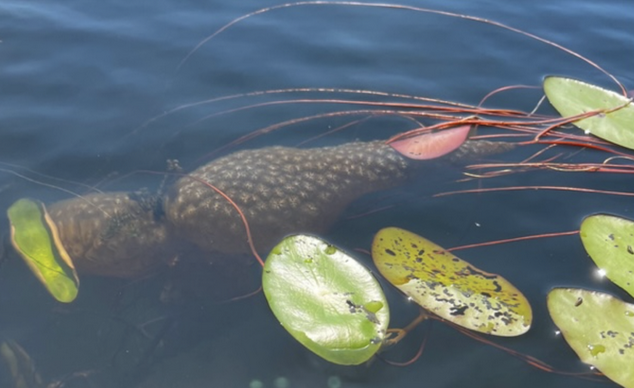
Large numbers of small dead fish → Mayfly exoskeletons
Throughout the spring and summer, mayflies leave behind their exoskeletons when they hatch, moving from their aquatic life stage to their terrestrial one. Due to their fish-like appearance, they are sometimes confused with fish kills (an unexpected and sudden appearance of dead fish over a short period of time). If you suspect a fish kill, you can report your concerns to Inland Fisheries and Wildlife here.

Oily sheen → Organism decomposition
You may have seen rainbow colored puddles in parking lots from spilled petroleum that look similar to the sheen in some sections of lakes and ponds. This may be a result of the natural decomposition of organisms. How can you tell the difference between the product of decomposition and a pollutant spill? Give the sheen a poke; if it breaks apart and does not flow back together, it’s decomposing matter. If it immediately swirls back together, it could be a pollutant.
This article was included in 30 Mile’s September 2025 newsletter. To view the full newsletter, click here.